The worldwide uptake of GPS guidance systems in agriculture has grown exponentially over the past 10 years. With its growth, more and more companies have begun developing their own systems, and as a result, the cost of these systems to the end user has reduced significantly.
The majority of new tractors sold in Europe are now coming as auto-steer ready, meaning these tractors have the core hardware such as steering valves, sensors and wiring, etc., already installed. This essentially allows for a ‘plug-and-play’ addition of an auto-steer system, which is simply made up of a receiver and a display screen.
This is great, but in reality, a significant amount of work is still carried out in Ireland and across Europe with older tractors- whether that be trusty 6930 John Deeres, T7030 New Hollands or the likes of a 6480 Massey Ferguson, you get the picture.
They say you can’t teach an old dog new tricks, but you can successfully retrofit GPS guidance systems to older tractors. The GPS retrofit market is massive - but often times potential buyers can be overwhelmed by the many options available.
As with all elements of agricultural machinery at present, Chinese manufacturers are heavily investing and beginning to garner a share of the European market.

"Once I drive around each field once, I have those boundaries saved forever - likewise, with my AB lines."
This is no different with technology, with several brands making in-roads into the GPS market, including CHC Nav, which we look at in this article.
Moving to GPS
Farming between Athy and Castledermot in Co Kildare, Thomas Greene is a full-time tillage farmer, growing a mix of winter and spring cereals, oilseed rape, peas and beans, all of which are established by direct drilling.
In 2021, Thomas bought a Valtra N174, which was kitted out with Valtra Guide which is Valtra’s integrated GPS guidance system, from Trimble.
For its first year on the farm, Thomas used the entry-level RangePoint RTX, which is accurate to six inches (15cm). It offered better accuracy than free systems, but it requires a paid annual subscription for activation, which in Thomas’s case was around €600/year.
Keen to improve his efficiency while drilling, he upgraded to CentrePoint, which is a higher-accuracy correction service. This offers accuracy around two inches (5cm), and came with an annual subscription fee of just over €1,000/year.
Thomas explained that this was definitely a good upgrade, and worked well. However, when he went for seed to fill the drill, the AB lines would have drifted by the time he got back to the field. After three years using GPS, Thomas made up his mind that he wanted to go to the highest level of steering accuracy, namely RTK (Real-Time Kinematic).
This is high-precision positioning that uses fixed base stations to send correction data to the mobile SIM receiver in the tractor, to offer consistent 1-2cm accuracy.
Variable rate seeding
Very much a progressive farmer, Thomas has worked hard to build soil structures and fertility on his farm and today practises 100% direct drilling.
Keen to make informed decisions to maximise productivity while keeping expenditure to a minimum, Thomas felt that variable rate sowing and fertilising was the next step. In order to do this, a combine yield monitor was the starting point and necessity to gather yield data.
A few years ago, he retrofitted a FarmTRX yield monitor and moisture meter to the combine. He uses this, in combination with Farmplan as a third-party platform to view and analyse the data collected and help make cropping decisions. He has since been using this data to dabble with variable rate fertiliser application and variable rate seeding.

He initially bought the auto steer system for the combine to generate accurate data, which he wanted for creating variable rate application maps.
For him to generate accurate data, he needed to fit a GPS autosteer system to his combine.
Buying a retrofit GPS system
Thomas carefully looked at five retrofit GPS systems on the Irish market. These were FJ Dynamics, Field Bee, Sveaverken, Trimble and CHC Nav.
He explained that it was a big investment for his farm, so he had to carefully look into dealer backup, pricing and system usability. After much deliberation, he went with CHC Nav. He had several reasons – first was dealer backup. J Leech Agri in Wexford is the Irish importer and distributor for CHC Nav, and Thomas noted that he is very approachable and willing and excellent at his job.
Second was the price. Although the physical unit was priced in the middle of the five brands he priced, Thomas explained that when he took the RTK subscription into consideration, the CHC Nav system actually worked out the cheapest.
What is CHC?
CHC is a Chinese company with a European base in Hungary. They employ 2,000 people worldwide with 50% of these working in R&D. The company was established in 2003 and is now a big player in the world of GPS players across the geospatial, machine control, navigation and agriculture segments. CHC launched their first precision Agriculture products in 2017 and since then, the agricultural division of the company has grown to become the largest part of the business. In 2023 they entered the UK market followed by the Irish market in 2024 with Wexford importer J Leech Agri Ltd. This firms is headed up by Jonathan Leech, who many will know from his 20 plus years in agri machinery sales.
One GPS system for two machines
Thomas made the decision to go with the CHC Nav NX 612 automated steering system. It connects seamlessly to the GNSS RTK network, providing +/-2.5cm accuracy without network coverage.
It comes with either a 10 or 12-inch HD display. With prices starting from €6,000 plus VAT, this system qualifies for the TAMS grant aid of 40%, or 60% for young farmers for GPS systems under the Tillage Capital Investment Scheme (TCIS).
Jonathan Leech from J Leech Agri fitted the system into Thomas’s 2012 Claas Lexion 630 combine this year. Thomas also purchased a second complete wiring loom, which he fitted himself to his 2000 New Holland TS 115 tractor.
The thinking behind this was to maximise the use of the one unit, allowing for poinpoint spraying and fertiliser application on his New Holland, while swapping the system over to his combine for the harvest.
These systems being fitted to non-auto-steer ready machines essentially come with four pieces- the steering wheel and motor, the wiring harness, the receiver and the display screen. The wiring harness is wired directly to the battery. From the battery, one wire goes to the display screen, one goes to the receiver on the roof and the other goes to the steering wheel motor.
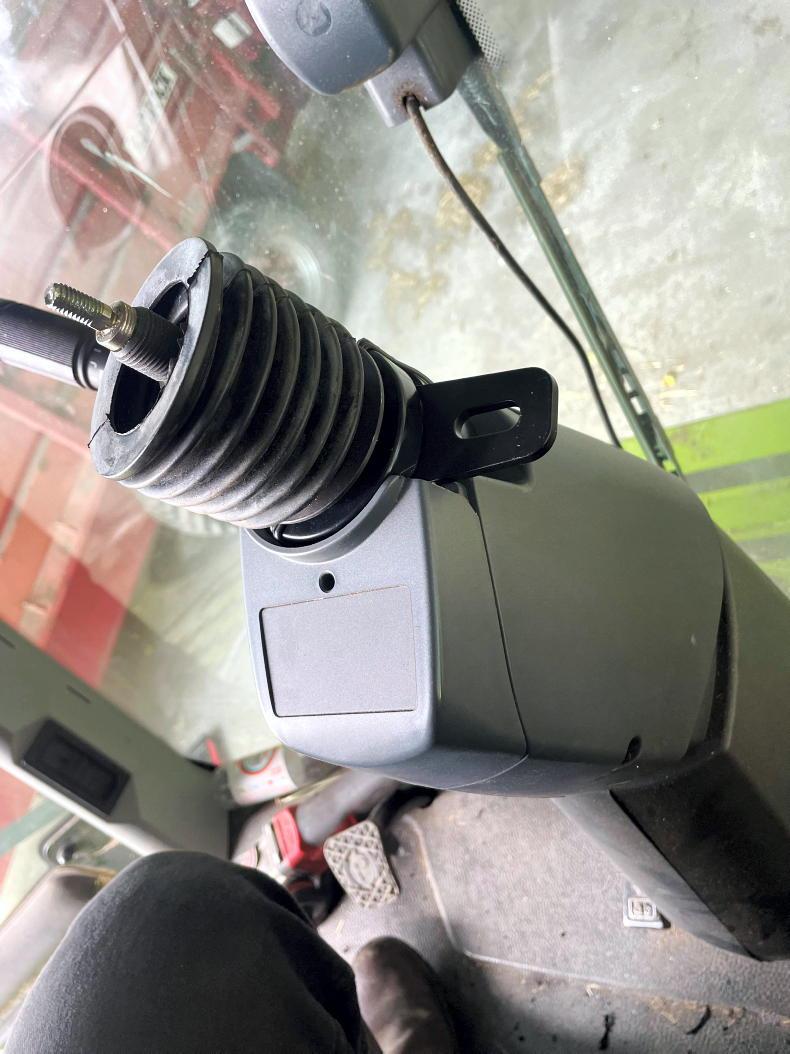
“The installation process took three to four hours on the combine. You could install it a lot quicker, it’s the routing of the wires in a tidy manner that takes up a lot of the time".
“The installation process took around three to four hours on the combine. You could install it a lot quicker, it’s the routing of the wires in a tidy manner that takes up a lot of the time,” said Thomas.
“I installed the wiring harness on the TS 115 myself. Once I’d seen Jonathan installing it on the combine, it was simple to replicate. To fit the harness in a tidy manner on the TS 115, it took me around three hours. Now if you were in a panic, you would stick it on in less than an hour.
“When swapping between the combine and the tractor, I move the steering wheel, receiver and the screen. This takes around 20 minutes, and a further 10 minutes to set the machine parameters and calibrate.”

Thomas uses the system on his 2000 New Holland TS 115 for pin-point spraying and fertiliser application, while swapping the system over to his combine for the harvest.
RTK connection
One of the major draws for Thomas to the CHC Nav system was J Leech Agri’s own RTK NTrip Network, named JL AgNet. The firm’s recently developed country-wide network of base stations provide RTK correction signals for their CHC units and the majority of other makes of auto-steer systems on the market.
The big draw to JL AgNet is the attractive pricing, which is close to half of some well-known brands. It priced at €650 plus VAT for the year, or €400 plus VAT for six months, including the rental of the multi-network SIM card.
They are also the first on the Irish market to offer a six-month RTK subscription option for spring tillage growers. Thomas decided to subscribe to JL AgNet for the RTK signal for his Trimble steering system in his N174 Valtra, alongside his CHC system. For this, J Leech fits a multi-network data sim in Thomas’s tractor’s GPS system and gives him his own login details for its Ntrip RTK network.
This has transitioned all of Thomas’s tractor work to the highest level of accuracy possible.
“I now have all of my fields, and a share of my neighbours’ fields who I often help out, saved on my system. Once I drive around each field once, I have those boundaries saved forever,” said Thomas.
“ Likewise, once I have my AB lines saved, they are there forever more. When you are working the same land year in, year out, it makes life very simple. My 74-year-old father now uses it to spray and spread fertiliser. If he can use it, anyone can!”
Verdict
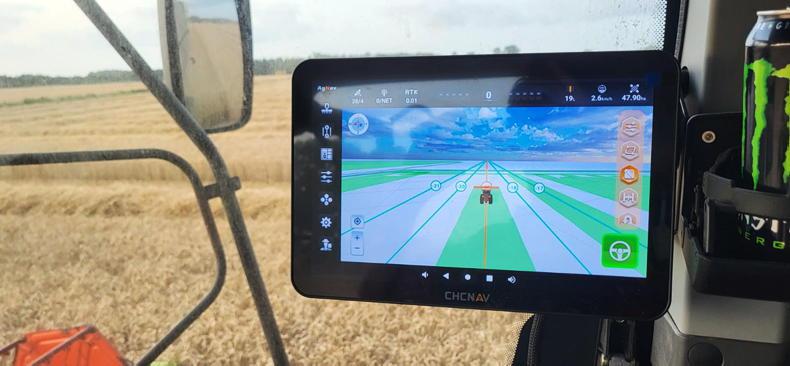
“After my first year with the CHC Nav system, I love it. It has been 100% reliable, and I have had no faults whatsoever from that side. The screen is well-laid out and it looks good- the graphics are tidy,” said Thomas.
“I find that RTK network is very solid, it’s constantly picking up 30+ satellites. The addition of RTK steering to the combine has allowed me to create extremely accurate yield maps. Based on these maps, I will be creating variable rate seed maps for 40 acres of direct drilling on the farm this spring.
“I do have one minor issue with the system. Some of the Chinese to English wording translations in the main menu screen need to be slightly tweaked, but its fine once you get used to it.
“As both my machines weren’t auto-steer ready, a wheel motor had to be fitted. When disengaging auto-steer with the motor system, you need to give it a fair tug to disarm the system, in comparison to an auto-steer ready tractor, which goes through the steering valve.
“I think CHC, like other companies, recommend disengaging it by using the trigger button. This isn’t a CHC problem, it’s common amongst retrofitted steering systems. When using the tractor with manual steering, such as on the road, the wheel is no heavier than the standard wheel. The knob on the steering wheel itself is handy. A little more of a premium feel to the steering wheel would help it along a bit more, but as aftermarket GPS kits go, it’s in line with the other options.
“Overall, the system has worked a treat, and the backup has been top class. The system has done everything I have asked of it.”
The worldwide uptake of GPS guidance systems in agriculture has grown exponentially over the past 10 years. With its growth, more and more companies have begun developing their own systems, and as a result, the cost of these systems to the end user has reduced significantly.
The majority of new tractors sold in Europe are now coming as auto-steer ready, meaning these tractors have the core hardware such as steering valves, sensors and wiring, etc., already installed. This essentially allows for a ‘plug-and-play’ addition of an auto-steer system, which is simply made up of a receiver and a display screen.
This is great, but in reality, a significant amount of work is still carried out in Ireland and across Europe with older tractors- whether that be trusty 6930 John Deeres, T7030 New Hollands or the likes of a 6480 Massey Ferguson, you get the picture.
They say you can’t teach an old dog new tricks, but you can successfully retrofit GPS guidance systems to older tractors. The GPS retrofit market is massive - but often times potential buyers can be overwhelmed by the many options available.
As with all elements of agricultural machinery at present, Chinese manufacturers are heavily investing and beginning to garner a share of the European market.
"Once I drive around each field once, I have those boundaries saved forever - likewise, with my AB lines."
This is no different with technology, with several brands making in-roads into the GPS market, including CHC Nav, which we look at in this article.
Moving to GPS
Farming between Athy and Castledermot in Co Kildare, Thomas Greene is a full-time tillage farmer, growing a mix of winter and spring cereals, oilseed rape, peas and beans, all of which are established by direct drilling.
In 2021, Thomas bought a Valtra N174, which was kitted out with Valtra Guide which is Valtra’s integrated GPS guidance system, from Trimble.
For its first year on the farm, Thomas used the entry-level RangePoint RTX, which is accurate to six inches (15cm). It offered better accuracy than free systems, but it requires a paid annual subscription for activation, which in Thomas’s case was around €600/year.
Keen to improve his efficiency while drilling, he upgraded to CentrePoint, which is a higher-accuracy correction service. This offers accuracy around two inches (5cm), and came with an annual subscription fee of just over €1,000/year.
Thomas explained that this was definitely a good upgrade, and worked well. However, when he went for seed to fill the drill, the AB lines would have drifted by the time he got back to the field. After three years using GPS, Thomas made up his mind that he wanted to go to the highest level of steering accuracy, namely RTK (Real-Time Kinematic).
This is high-precision positioning that uses fixed base stations to send correction data to the mobile SIM receiver in the tractor, to offer consistent 1-2cm accuracy.
Variable rate seeding
Very much a progressive farmer, Thomas has worked hard to build soil structures and fertility on his farm and today practises 100% direct drilling.
Keen to make informed decisions to maximise productivity while keeping expenditure to a minimum, Thomas felt that variable rate sowing and fertilising was the next step. In order to do this, a combine yield monitor was the starting point and necessity to gather yield data.
A few years ago, he retrofitted a FarmTRX yield monitor and moisture meter to the combine. He uses this, in combination with Farmplan as a third-party platform to view and analyse the data collected and help make cropping decisions. He has since been using this data to dabble with variable rate fertiliser application and variable rate seeding.
He initially bought the auto steer system for the combine to generate accurate data, which he wanted for creating variable rate application maps.
For him to generate accurate data, he needed to fit a GPS autosteer system to his combine.
Buying a retrofit GPS system
Thomas carefully looked at five retrofit GPS systems on the Irish market. These were FJ Dynamics, Field Bee, Sveaverken, Trimble and CHC Nav.
He explained that it was a big investment for his farm, so he had to carefully look into dealer backup, pricing and system usability. After much deliberation, he went with CHC Nav. He had several reasons – first was dealer backup. J Leech Agri in Wexford is the Irish importer and distributor for CHC Nav, and Thomas noted that he is very approachable and willing and excellent at his job.
Second was the price. Although the physical unit was priced in the middle of the five brands he priced, Thomas explained that when he took the RTK subscription into consideration, the CHC Nav system actually worked out the cheapest.
What is CHC?
CHC is a Chinese company with a European base in Hungary. They employ 2,000 people worldwide with 50% of these working in R&D. The company was established in 2003 and is now a big player in the world of GPS players across the geospatial, machine control, navigation and agriculture segments. CHC launched their first precision Agriculture products in 2017 and since then, the agricultural division of the company has grown to become the largest part of the business. In 2023 they entered the UK market followed by the Irish market in 2024 with Wexford importer J Leech Agri Ltd. This firms is headed up by Jonathan Leech, who many will know from his 20 plus years in agri machinery sales.
One GPS system for two machines
Thomas made the decision to go with the CHC Nav NX 612 automated steering system. It connects seamlessly to the GNSS RTK network, providing +/-2.5cm accuracy without network coverage.
It comes with either a 10 or 12-inch HD display. With prices starting from €6,000 plus VAT, this system qualifies for the TAMS grant aid of 40%, or 60% for young farmers for GPS systems under the Tillage Capital Investment Scheme (TCIS).
Jonathan Leech from J Leech Agri fitted the system into Thomas’s 2012 Claas Lexion 630 combine this year. Thomas also purchased a second complete wiring loom, which he fitted himself to his 2000 New Holland TS 115 tractor.
The thinking behind this was to maximise the use of the one unit, allowing for poinpoint spraying and fertiliser application on his New Holland, while swapping the system over to his combine for the harvest.
These systems being fitted to non-auto-steer ready machines essentially come with four pieces- the steering wheel and motor, the wiring harness, the receiver and the display screen. The wiring harness is wired directly to the battery. From the battery, one wire goes to the display screen, one goes to the receiver on the roof and the other goes to the steering wheel motor.
“The installation process took three to four hours on the combine. You could install it a lot quicker, it’s the routing of the wires in a tidy manner that takes up a lot of the time".
“The installation process took around three to four hours on the combine. You could install it a lot quicker, it’s the routing of the wires in a tidy manner that takes up a lot of the time,” said Thomas.
“I installed the wiring harness on the TS 115 myself. Once I’d seen Jonathan installing it on the combine, it was simple to replicate. To fit the harness in a tidy manner on the TS 115, it took me around three hours. Now if you were in a panic, you would stick it on in less than an hour.
“When swapping between the combine and the tractor, I move the steering wheel, receiver and the screen. This takes around 20 minutes, and a further 10 minutes to set the machine parameters and calibrate.”
Thomas uses the system on his 2000 New Holland TS 115 for pin-point spraying and fertiliser application, while swapping the system over to his combine for the harvest.
RTK connection
One of the major draws for Thomas to the CHC Nav system was J Leech Agri’s own RTK NTrip Network, named JL AgNet. The firm’s recently developed country-wide network of base stations provide RTK correction signals for their CHC units and the majority of other makes of auto-steer systems on the market.
The big draw to JL AgNet is the attractive pricing, which is close to half of some well-known brands. It priced at €650 plus VAT for the year, or €400 plus VAT for six months, including the rental of the multi-network SIM card.
They are also the first on the Irish market to offer a six-month RTK subscription option for spring tillage growers. Thomas decided to subscribe to JL AgNet for the RTK signal for his Trimble steering system in his N174 Valtra, alongside his CHC system. For this, J Leech fits a multi-network data sim in Thomas’s tractor’s GPS system and gives him his own login details for its Ntrip RTK network.
This has transitioned all of Thomas’s tractor work to the highest level of accuracy possible.
“I now have all of my fields, and a share of my neighbours’ fields who I often help out, saved on my system. Once I drive around each field once, I have those boundaries saved forever,” said Thomas.
“ Likewise, once I have my AB lines saved, they are there forever more. When you are working the same land year in, year out, it makes life very simple. My 74-year-old father now uses it to spray and spread fertiliser. If he can use it, anyone can!”
Verdict
“After my first year with the CHC Nav system, I love it. It has been 100% reliable, and I have had no faults whatsoever from that side. The screen is well-laid out and it looks good- the graphics are tidy,” said Thomas.
“I find that RTK network is very solid, it’s constantly picking up 30+ satellites. The addition of RTK steering to the combine has allowed me to create extremely accurate yield maps. Based on these maps, I will be creating variable rate seed maps for 40 acres of direct drilling on the farm this spring.
“I do have one minor issue with the system. Some of the Chinese to English wording translations in the main menu screen need to be slightly tweaked, but its fine once you get used to it.
“As both my machines weren’t auto-steer ready, a wheel motor had to be fitted. When disengaging auto-steer with the motor system, you need to give it a fair tug to disarm the system, in comparison to an auto-steer ready tractor, which goes through the steering valve.
“I think CHC, like other companies, recommend disengaging it by using the trigger button. This isn’t a CHC problem, it’s common amongst retrofitted steering systems. When using the tractor with manual steering, such as on the road, the wheel is no heavier than the standard wheel. The knob on the steering wheel itself is handy. A little more of a premium feel to the steering wheel would help it along a bit more, but as aftermarket GPS kits go, it’s in line with the other options.
“Overall, the system has worked a treat, and the backup has been top class. The system has done everything I have asked of it.”








SHARING OPTIONS